Showing posts with label AI. Show all posts

The Handbook of Data Mining (Human Factors and Ergonomics)


The Handbook of Data Mining (Human Factors and Ergonomics)
~
Nong Ye (Author)


Review

This handbook will be a valuable reference in the library of the human factors analyst with advanced statistical and analytic skills. The coverage is comprehensive and state-of-the-art by leading experts in data mining. The handbook is a tool kit to be consulted and referenced in the decision to conduct and plan a data-mining effort.
—Ergonomics in Design

...a useful resource for anyone new to data mining, and for anyone wishing to discover what potential tools are available, as well as what might be achieved through the use of those tools...a good 'data-mining handbook' to have on one's shelves.
—Short Book Reviews

This collection of essays contains chapters on many of the common techniques, problems, and applications associated with data mining....overall this book is an excellent reference for practitioners who need a practical introduction to topics in data mining.

—Journal of the American Statistical Association


This handbook will be a valuable reference in the library of the human factors analyst with advanced statistical and analytic skills. The coverage is comprehensive and state-of-the-art by leading experts in data mining. The handbook is a tool kit to be consulted and referenced in the decision to conduct and plan a data-mining effort.
—Ergonomics in Design

...a useful resource for anyone new to data mining, and for anyone wishing to discover what potential tools are available, as well as what might be achieved through the use of those tools...a good data-mining handbook to have on ones shelves.
—Short Book Reviews

This collection of essays contains chapters on many of the common techniques, problems, and applications associated with data mining....overall this book is an excellent reference for practitioners who need a practical introduction to topics in data mining.

—Journal of the American Statistical Association


Product Description
Created with the input of a distinguished International Board of the foremost authorities in data mining from academia and industry, The Handbook of Data Mining presents comprehensive coverage of data mining concepts and techniques. Algorithms, methodologies, management issues, and tools are all illustrated through engaging examples and real-world applications to ease understanding of the materials.

This book is organized into three parts. Part I presents various data mining methodologies, concepts, and available software tools for each methodology. Part II addresses various issues typically faced in the management of data mining projects and tips on how to maximize outcome utility. Part III features numerous real-world applications of these techniques in a variety of areas, including human performance, geospatial, bioinformatics, on- and off-line customer transaction activity, security-related computer audits, network traffic, text and image, and manufacturing quality.

This Handbook is ideal for researchers and developers who want to use data mining techniques to derive scientific inferences where extensive data is available in scattered reports and publications. It is also an excellent resource for graduate-level courses on data mining and decision and expert systems methodology.
Product Details

* Paperback: 720 pages
* Publisher: Lawrence Erlbaum Associates; 1 edition (November 30, 2004)
* Language: English
* ISBN-10: 0805855637
* ISBN-13: 978-0805855630

Download here
Science, mathematics, physics,chemistry, informatics, etc..
www.mathlib.org


Read more...

Spoken Language Processing: A Guide to Theory, Algorithm and System Development


Spoken Language Processing: A Guide to Theory, Algorithm and System Development
~
Alex Acero (Author), Hsiao-Wuen Hon (Author)


Product Description
Offers coverage of new advances in spoken language processing in computer science, drawing on the most recent discoveries in computer science, electrical engineering, mathematics, and other fields. Covers speech recognition, speech processing, spoken language understanding, speech synthesis, and speech interface design. DLC: Natural language processing (Computer science).


From the Inside Flap
Preface

Our primary motivation in writing this book is to share our working experience to bridge the gap between the knowledge of industry gurus and newcomers to the spoken language processing community. Many powerful techniques hide in conference proceedings and academic papers for years before becoming widely recognized by the research community or the industry. We spent many years pursuing spoken language technology research at Carnegie Mellon University before we started spoken language R&D at Microsoft. We fully understand that it is by no means a small undertaking to transfer a state-of-the-art spoken language research system into a commercially viable product that can truly help people improve their productivity. Our experience in both industry and academia is reflected in the context of this book, which presents a contemporary and comprehensive description of both theoretic and practical issues in spoken language processing. This book is intended for people of diverse academic and practical backgrounds. Speech scientists, computer scientists, linguists, engineers, physicists, and psychologists all have a unique perspective on spoken language processing. This book will be useful to all of these special interest groups.

Spoken language processing is a diverse subject that relies on knowledge of many levels, including acoustics, phonology, phonetics, linguistics, semantics, pragmatics, and discourse. The diverse nature of spoken language processing requires knowledge in computer science, electrical engineering, mathematics, syntax, and psychology. There are a number of excellent books on the subfields of spoken language processing, including speech recognition, text-to-speech conversion, and spoken language understanding, but there is no single book that covers both theoretical and practical aspects of these subfields and spoken language interface design. We devote many chapters systematically introducing fundamental theories needed to understand how speech recognition, text-to-speech synthesis, and spoken language understanding work. Even more important is the fact that the book highlights what works well in practice, which is invaluable if you want to build a practical speech recognizer, a practical text-to-speech synthesizer, or a practical spoken language system. Using numerous real examples in developing Microsoft's spoken language systems, we concentrate on showing how the fundamental theories can be applied to solve real problems in spoken language processing.
# Paperback: 1008 pages
# Publisher: Prentice Hall PTR (May 5, 2001)
# Language: English
# ISBN-10: 0130226165
# ISBN-13: 978-0130226167

Download here
Science, mathematics, physics,chemistry, informatics, etc..
www.mathlib.org


Read more...

Mathematical Methods for Knowledge Discovery and Data Mining (Premier Reference Source)


Mathematical Methods for Knowledge Discovery and Data Mining (Premier Reference Source)
~
Giovanni Felici (Author, Editor), Carlo Vercellis (Editor)


Product Description
The field of data mining has seen a demand in recent years for the development of ideas and results in an integrated structure. Mathematical Methods for Knowledge Discovery & Data Mining focuses on the mathematical models and methods that support most data mining applications and solution techniques, covering such topics as association rules; Bayesian methods; data visualization; kernel methods; neural networks; text, speech, and image recognition; and many others. This Premier Reference Source is an invaluable resource for scholars and practitioners in the fields of biomedicine, engineering, finance and insurance, manufacturing, marketing, performance measurement, and telecommunications.


About the Author
Giovanni Felici graduated in statistics at the University of Rome ?La Sapienza.? He received his MSc in operations research and operations management at the University of Lancaster, UK, in 1990, and his PhD in operations research at the University of Rome ?La Sapienza.? He is presently a permanent researcher at IASI, the Istituto di Analisi dei Sistemi ed Informatica of the National Research Council (CNR), Italy, where he started his research activity in 1994 working on research projects in logic programming and mathematical optimization. His current research activity is mainly devoted to to the application of optimization techniques to data-mining problems, with particular focus on integer programming algorithms for learning in logic and expert systems.

Carlo Vercellis is full professor at the Politecnico di Milano, where he teaches courses in optimization and business intelligence. He is also director of the research group MOLD?mathematical modeling, optimization, learning from data. He has coordinated national and international research programs funded by EEC, CNR, and MIUR. His current research interests include mathematical models for learning, such as support vector machines and classification trees; data mining and machine learning, and their applications to relational marketing and biolife sciences; optimization models and methods, in particular with applications to supply chain and revenue management. --This text refers to the Digital edition.
Product Details

* Hardcover: 371 pages
* Publisher: Idea Group Reference (October 4, 2007)
* Language: English
* ISBN-10: 1599045281
* ISBN-13: 978-1599045283

Download here
Science, mathematics, physics,chemistry, informatics, etc..
www.mathlib.org


Read more...

Syntactic pattern recognition


Syntactic pattern recognition
~
Fu K.S., et al. (eds.)


# Hardcover: 596 pages
# Publisher: Prentice Hall (December 1981)
# Language: English
# ISBN-10: 0138801207
# ISBN-13: 978-0138801205

Download here
Science, mathematics, physics,chemistry, informatics, etc..
www.mathlib.org


Read more...

The elements of statistical learning: Data mining, inference, and prediction


The elements of statistical learning: Data mining, inference, and prediction
~
Friedman J., Hastie T., Tibshirani R.


Review

From the Reviews:

"Like the first edition, the current one is a welcome edition to researchers and academicians equally…. Almost all of the chapters are revised.… The Material is nicely reorganized and repackaged, with the general layout being the same as that of the first edition.… If you bought the first edition, I suggest that you buy the second editon for maximum effect, and if you haven’t, then I still strongly recommend you have this book at your desk. Is it a good investment, statistically speaking!" (Book Review Editor, Technometrics, August 2009, VOL. 51, NO. 3)


Product Description

During the past decade there has been an explosion in computation and information technology. With it have come vast amounts of data in a variety of fields such as medicine, biology, finance, and marketing. The challenge of understanding these data has led to the development of new tools in the field of statistics, and spawned new areas such as data mining, machine learning, and bioinformatics. Many of these tools have common underpinnings but are often expressed with different terminology. This book describes the important ideas in these areas in a common conceptual framework. While the approach is statistical, the emphasis is on concepts rather than mathematics. Many examples are given, with a liberal use of color graphics. It is a valuable resource for statisticians and anyone interested in data mining in science or industry. The book's coverage is broad, from supervised learning (prediction) to unsupervised learning. The many topics include neural networks, support vector machines, classification trees and boosting---the first comprehensive treatment of this topic in any book.

This major new edition features many topics not covered in the original, including graphical models, random forests, ensemble methods, least angle regression & path algorithms for the lasso, non-negative matrix factorization, and spectral clustering. There is also a chapter on methods for ``wide'' data (p bigger than n), including multiple testing and false discovery rates.

Trevor Hastie, Robert Tibshirani, and Jerome Friedman are professors of statistics at Stanford University. They are prominent researchers in this area: Hastie and Tibshirani developed generalized additive models and wrote a popular book of that title. Hastie co-developed much of the statistical modeling software and environment in R/S-PLUS and invented principal curves and surfaces. Tibshirani proposed the lasso and is co-author of the very successful An Introduction to the Bootstrap. Friedman is the co-inventor of many data-mining tools including CART, MARS, projection pursuit and gradient boosting.
# Hardcover: 746 pages
# Publisher: Springer; 2nd ed. 2009. Corr. 3rd printing edition (September 15, 2009)
# Language: English
# ISBN-10: 0387848576
# ISBN-13: 978-0387848570

Download here
Science, mathematics, physics,chemistry, informatics, etc..
www.mathlib.org


Read more...

Handbook on decision support systems 2: Variations


Handbook on decision support systems 2: Variations
~
Burstein F., Holsapple C. (eds.)


Product Description

As the most comprehensive reference work dealing with decision support systems (DSS), this book is essential for the library of every DSS practitioner, researcher, and educator. Written by an international array of DSS luminaries, its more than 70 chapters approach decision support systems from a wide variety of perspectives ranging from classic foundations to cutting-edge thought, informative to provocative, theoretical to practical, historical to futuristic, human to technological, and operational to strategic. The chapters are conveniently organized into 10 major sections: foundations of decision support systems, DSS fundamentals, multiparticipant DSSs, intelligent DSSs, effects of decision support, time & space issues, scopes of decision support, developing & managing decision support systems, cases &applications, and decision support horizons. Novices and experts alike will refer to the authoritative and stimulating content again and again for years to come.
Product Details

* Hardcover: 800 pages
* Publisher: Springer; 1 edition (February 25, 2008)
* Language: English
* ISBN-10: 3540487158
* ISBN-13: 978-3540487159

Download here
Science, mathematics, physics,chemistry, informatics, etc..
www.mathlib.org


Read more...

Handbook on decision support systems 1: Basic Themes


Handbook on decision support systems 1: Basic Themes
~
Frada Burstein (Author, Editor), Clyde W. Holsapple (Editor)


Product Description

Decision support systems have experienced a marked increase in attention and importance over the past 25 years. The aim of this book is to survey the decision support system (DSS) field covering both developed territory and emergent frontiers. It will give the reader a clear understanding of fundamental DSS concepts, methods, technologies, trends, and issues. It will serve as a basic reference work for DSS research, practice, and instruction. To achieve these goals, the book has been designed according to a ten-part structure, divided in two volumes with chapters authored by well-known, well-versed scholars and practitioners from the DSS community.
Product Details

* Hardcover: 854 pages
* Publisher: Springer; 1 edition (February 25, 2008)
* Language: English
* ISBN-10: 3540487123
* ISBN-13: 978-3540487128

Download here
Science, mathematics, physics,chemistry, informatics, etc..
www.mathlib.org


Read more...

Prolog programming for artificial intelligence


Prolog programming for artificial intelligence
~
Bratko I.


Product Description
The third edition of this guide to Prolog and Artificial Intelligence has been updated to include key developments in the field. Divided into two parts, the first part of the book introduces the programming language Prolog, while the second part teaches Artificial Intelligence using Prolog as a tool for the implementation of AI techniques. --This text refers to an out of print or unavailable edition of this title.


From the Back Cover
This best-selling guide to Prolog has been fully revised and extended to provide an even greater range of applications, enhancing its value as a stand-alone guide to Prolog, artificial intelligence, or AI programming. Ivan Bratko discusses natural language processing with grammar rules, planning, and machine learning. The coverage of meta-programming includes meta-interpreters and object-oriented programming in Prolog. The new edition includes coverage of: constraint logic programming; qualitative reasoning; inductive logic programming; recently developed algorithms; belief networks for handling uncertainty; and a major update on machine learning. This book is aimed at programmers who need to learn AI programming. --This text refers to an out of print or unavailable edition of this title.
Product Details

* Paperback: 736 pages
* Publisher: Addison-Wesley Educational Publishers Inc; 4th edition (August 16, 2010)
* Language: English
* ISBN-10: 0321417461
* ISBN-13: 978-0321417466

Download here
Science, mathematics, physics,chemistry, informatics, etc..
www.mathlib.org


Read more...

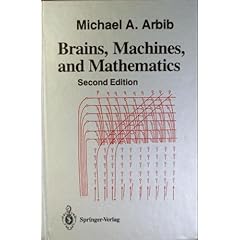
Brains, machines, and mathematics


Brains, machines, and mathematics
~
Arbib M.A.


Product Description
Traces the relationship between the development of computing machines and our knowledge of brain functioning, and introduces corresponding mathematical models designed to describe this relationship. Begins with a historical overview tracing the rise of cybernetics to the current interchange of ideas between AI and brain theory. Subsequent chapters introduce neural sets and finite automata, the crucial cybernetic concepts of feedback and realization, pattern recognition networks, "semi-neural" learning networks, capabilities of Turing machines and automata which construct as well as compute. The final chapter presents two accessible proofs of Gödel's Incompleteness Theorem.
Product Details

* Hardcover: 202 pages
* Publisher: Springer; 2nd edition (October 5, 1987)
* Language: English
* ISBN-10: 0387965394
* ISBN-13: 978-0387965390

Download here
Science, mathematics, physics,chemistry, informatics, etc..
www.mathlib.org


Read more...

Encyclopedia of decision making and decision support technologies


Encyclopedia of decision making and decision support technologies
~
Frederic Adam (Author, Editor), Patrick Humphreys (Editor)


Review
"Overall, Adam and Humphreys have successfully brought together a wide range of topics into a simple collection of well-written essays. Academic in nature, this encyclopedia will be useful to those who make decision support systems, as well as those who work n the development of decision support technologies." --American Reference Annual, Vol. 40 (2009)


Product Description
As effective organizational decision making is a major factor in a companys success, a coherent, comprehensive account of current available research on the core concepts of the decision support agenda, is in high demand by academicians and professionals alike.

The Encyclopedia of Decision Making and Decision Support Technologies presents a critical mass of research on the most up-to-date research on human and computer support of managerial decision making, including discussion on support of operational, tactical, and strategic decisions, human vs. computer system support structure, individual and group decision making, and multi-criteria decision making.
# Hardcover: 1064 pages
# Publisher: Information Science Reference (April 22, 2008)
# Language: English
# ISBN-10: 1599048434
# ISBN-13: 978-1599048437

Download here
Science, mathematics, physics,chemistry, informatics, etc..
www.mathlib.org


Read more...

Analysis and Applications of Artificial Neural Networks


Analysis and Applications of Artificial Neural Networks
~
L. P. J. Veelenturf


Thorough, compact, and self-contained, this explanation and analysis of a broad range of neural nets is conveniently structured so that readers can first gain a quick global understanding of neural nets -- without the mathematics -- and can then delve into mathematical specifics as necessary. The behavior of neural nets is first explained from an intuitive perspective; the formal analysis is then presented; and the practical implications of the formal analysis are stated separately. Analyzes the behavior of the six main types of neural networks -- The Binary Perceptron, The Continuous Perceptron (Multi-Layer Perceptron), The Bidirectional Memories, The Hopfield Network (Associative Neural Nets), The Self-Organizing Neural Network of Kohonen, and the new Time Sequentional Neural Network. For technically-oriented individuals working with information retrieval, pattern recognition, speech recognition, signal processing, data classification.
# Textbook Binding: 368 pages
# Publisher: Prentice Hall; 1st edition (June 14, 1995)
# Language: English
# ISBN-10: 013489832X
# ISBN-13: 978-0134898322

Download here
Science, mathematics, physics,chemistry, informatics, etc..
www.mathlib.org


Read more...

Real World Applications of Computational Intelligence (Studies in Fuzziness and Soft Computing)


Real World Applications of Computational Intelligence (Studies in Fuzziness and Soft Computing)
~
Mircea G. Negoita (Editor), Bernd Reusch (Editor)


Product Description
Computational Intelligence (CI) has emerged as a novel and highly diversified paradigm supporting the design, analysis and deployment of intelligent systems. This book presents a careful selection of the field that very well reflects the breadth of the discipline. It covers a range of highly relevant and practical design principles governing the development of intelligent systems in data mining, robotics, bioinformatics, and intelligent tutoring systems. The lucid presentations, coherent organization, breadth and the authoritative coverage of the area make the book highly attractive for everybody interested in the design and analysis of intelligent systems.
Product Details

* Hardcover: 295 pages
* Publisher: Springer; 1 edition (August 11, 2005)
* Language: English
* ISBN-10: 3540250069
* ISBN-13: 978-3540250067

Download
Science, mathematics, physics,chemistry, informatics, etc..
www.mathlib.org


Read more...

AI Application Programming (Programming Series)

AI Application Programming (Programming Series)
by: M. Tim Jones


Details

# Paperback: 473 pages
# Publisher: Charles River Media; 2 edition (June 3, 2005)
# Language: English
# ISBN-10: 1584504218
# ISBN-13: 978-1584504214


Description
The popularity of artificial intelligence continues to grow as more and more uses are found for the technology. AI Application Programming Second Edition is completely updated to supply both the conceptual background and the real-world examples needed to begin using AI in software projects. Each technology is illustrated with a model implementation and application, and complete source code for each example is provided on the companion CD-ROM. Selected applications cover data mining, genetic algorithms, game programming, embedded rules-based engines, and the World Wide Web.

KEY FEATURES:
* Covers cutting-edge AI concepts such as neural networks, natural language processing, intelligent agents, genetic algorithms, rule-based systems, unsupervised learning algorithms, migratory software, and more
* Teaches each AI concept through a practical application, including a financial data miner, a Web spider, a networked data collector, a game program, an embedded battery charger control system, an embedded rules-based engine for log monitoring, and a fault tolerance subsystem
* Groups AI topics by conceptual subfields (machine learning, evolutionary methods, symbolic methods) for better "big picture" understanding and more focused specialization
* Provides a background in the history of AI, the distinct branches of this broad field, and the philosophical underpinnings and issues associated with these technologies
* Includes a CD-ROM (Win/Linux) with complete, fully commented source code in C for every application in the book
* Exercise sets for each chapter are located in Appendix A for use as a Textbook

Download
http://ifile.it/emvw4py/7212___ai_application_programming__1584502789_.rar


Read more...

AI Game Engine Programming (Game Development Series)

AI Game Engine Programming (Game Development Series)
by: Brian Schwab


Details

# Paperback: 624 pages
# Publisher: Charles River Media; 1 edition (September 2004)
# Language: English
# ISBN-10: 1584503440
# ISBN-13: 978-1584503446


Description
AI Game Engine Programming provides game developers with the tools and wisdom necessary to create modern game AI engines. It takes programmers from theory to actual game development, with usable code frameworks designed to go beyond merely detailing how a technique might be used. In addition, it surveys the capabilities of the different techniques used. In addition, it surveys the capabilities of the different techniques used in some current AI engines, and covers common pitfalls, design considerations, and optimizations. If you're having difficulty determining which techniques to use, or looking for working code best suited to a particular game, you'll find the answers here. You'll also find a clean, usable interface for a variety of game AI techniques with an emphasis on primary decision-making paradigms.

The book provides insightful coverage of a variety of subjects important to AI engine development, and ties them together masterfully to form an indispensable reference. Part I provides an overall look at game AI, covers the basic terminology used in the book, reviews underlying concepts of game AI, and dissects the parts of a game AI engine. Part II covers specific game genres (RPG, TRS, FTPS, Shooter, Sports, Racing, Strategy, Adventure, Fighting, Platform, and miscellaneous) and explains how they use different AU paradigms. It also covers the move common solutions to the problems posed by each genre. Some of the problems include, dealing with direct AI and human interactions, using scripting languages appropriately, and general intelligence/entertainment balancing. Part III provides the actual code implementations for the basic AI techniques such as finite state machines, fuzzy state machines, message board systems, scripted systems, and location-based information systems. And, Part IV covers the move advanced techniques, including genetic algorithms, neural networks, artificial life, planning algorithms, and decision trees. The book concludes with Part V, which looks at "real game AI development." The areas covered here focus on how distributed AI works as an overall paradigm that can help with the organization of any AI engine. There is also coverage of common AI development, debugging and tuning, and the future of AI.

After reading this book you'll have traveled through most of the huge landscape of knowledge that a game AI programmer faces, and you'll be prepared to master it!

Key Feature:
* Provides a detailed guide for programmers interested in creating an AI engine for and game genre
* Breaks down AI elements and solutions by genre, and provides concrete examples from popular games
* Includes code implementations for both basic and complex AI techniques
* Provides suggestions for how the AI systems discussed can be extended or optimized for space, speed, and other limitations
* Explains distributed AI as a paradigm that can help with the organization of almost any AI engine

On the CD-ROM
The CD-ROM includes all of the source code compiled using Microsoft Visual C++ 6.0, along with the compiled binaries; the GLUT wrapper for OpenGL library, and the Lua language library; useful bookmarks; and all the figures from the book.

System Requirements: Pentium 3.1 GHz or better, GeoForce Go or 3 graphics card or better, Windows (ME, 2000, or XP). The demonstration programs are written in Microsoft Visual C++ under the Windows platform, but only rendering is platform specific. The rendering API used is the GLUT extension to Open GL.


Download
http://ifile.it/c7ug0rq/1584503440.part1.rar
http://ifile.it/0mu3c4s/1584503440.part2.rar


Read more...